
Pipelines
Real AI systems require mixing jobs, multi-node training, autoscaling inference. Today, such systems are built with brittle glue code. Pipelines let you connect different workload types into a single pipeline.
Here's a hello world example that scrapes data, deploys a RAG server and a Discord server.
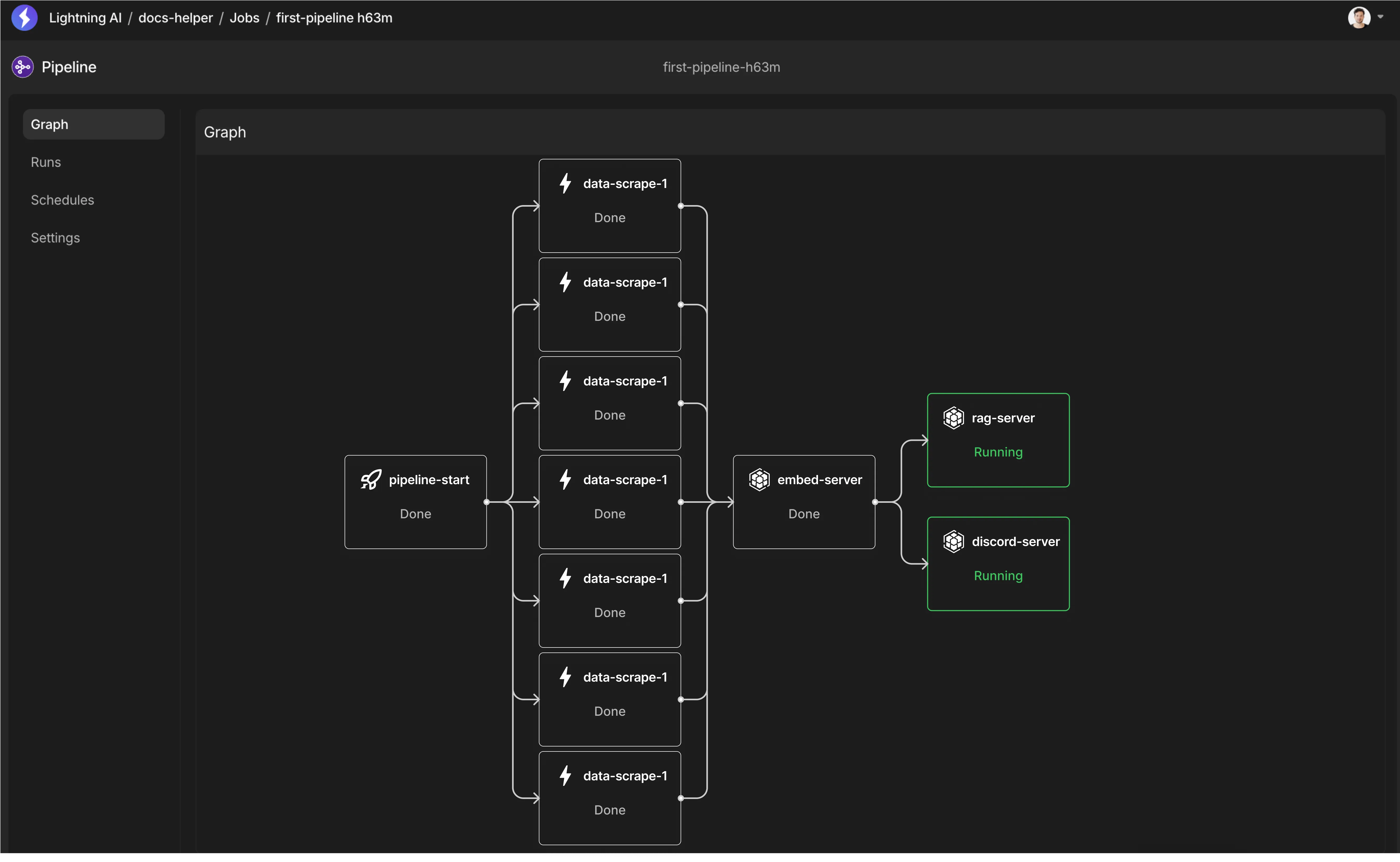
import lightning_sdk.pipeline as pipes
from lightning_sdk.machine import Machine

# pipeline definition
pipeline = pipes.Pipeline(name='third-pipeline')

# web scraper
web_scraper = pipes.JobStep(
    name='web-scraper',
    studio=Studio('web-scraper'),
    command="python web_scrapper.py"
)

# rag server
rag_server = pipes.DeploymentStep(
    name='rag-server',
    studio=Studio('rag-server'),
    command="python rag_scrapper.py"
    ports=[8000],
)

# discord bot
discord_server = pipes.DeploymentStep(
    name='discord-server',
    studio=Studio('discord-server'),
    command="python discord_server.py"
    ports=[8000],
)

# run pipeline
pipeline.run(
  steps=[web_scraper, rag_server, discord_server]
)
What are pipelines?
Lightning Pipelines let you compose AI-specific workflows from building blocks like:
- Batch Jobs - for large-scale data prep, evaluation, or simulation
- Multi-Machine Jobs (MMTs) - for distributed training and large compute
- Deployment Jobs - to launch scalable inference endpoints
Each step runs in its own environment, on the machine type it needs - no more juggling multiple tools, configs, or compute clusters.
Why Pipelines
Building real AI products means connecting many moving pieces:
- Data prep
- Training (often multi-node)
- Fine-tuning and evaluation
- Deployment
- Monitoring and retraining
Traditional orchestration tools weren’t designed for this. Lightning Pipelines are.
Lightning Pipeline enables to compose different Lightning AI resources such as Batch Job, Multi Machine Job or Deployment Job together.
Benefits
- ✅ AI-first orchestration: Purpose-built for workflows like multi-node training, hyperparameter sweeps, and terabyte-scale processing.
- ✅ No glue code: Define pipelines in code with simple, composable steps. No brittle scripts. No YAML hell.
- ✅ Run anywhere: Each step can use its own container, hardware, and scale - CPU, GPU, single-node or multi-node.
- ✅ Unified data access: Pipeline stages share a single filesystem, so no need to copy data between tools.
- ✅ Modular and future-proof: Easily swap out one step (e.g., LLaMA to DeepSeek) without rebuilding everything.
- ✅ CI/CD for AI: Automate retraining and redeployment on a schedule or new data arrival.
Was this page helpful?
Thanks for the feedback.