
Clusters
Lightning AI offers frontier-grade clusters with high-performance networking, storage and your choice of orchestrator.
To set up a cluster, contact our team.
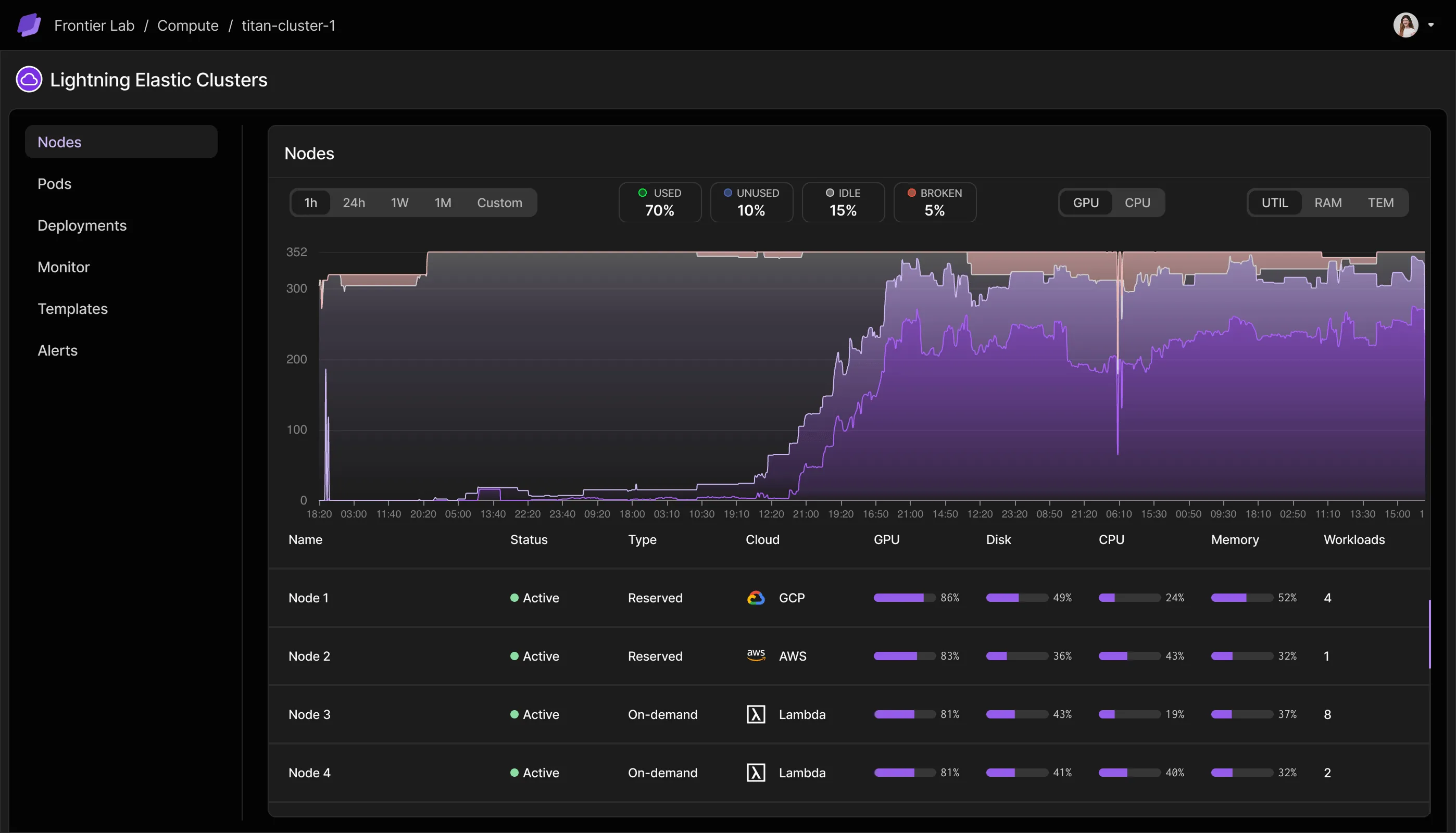
Index
Orchestrator comparison
SLURM and Kubernetes each take a different approach to orchestrating compute. SLURM excels in high-performance batch workloads, and Kubernetes brings container-based flexibility and control. Each has its strengths and trade-offs.
Here's a comparison that highlights them at a glance.
| Concept | Kubernetes | SLURM |
|---|---|---|
| Reserved machines | Node | Partition / Node |
| On-demand machines | Cluster resizing (manual, brittle) | Not native (requires schedulers & plugins) |
| Task type | Pod | Job script (sbatch, srun) |
| Single node training | Pod for training (YAML, schedulers) | srun / sbatch job |
| Multi-node training | Pod for training (YAML, schedulers) | srun / sbatch job (needs MPI plugin) |
| Inference | Pod for inference (stateless) | Not designed for inference |
| Development (IDE) | Pod for dev (ephemeral, YAML) | Interactive sessions |
| Data processing | Pod for data prep | Batch jobs (manual scripting) |
| Pipelines | DIY (Argo, Airflow, K8s operators) | DAGs with sbatch dependencies |
| Run PyTorch | Special operators or plugins. | srun + python script |
| File system | DIY (NFS, CSI drivers, config-heavy) | Shared FS (e.g., Lustre, GPFS) |
| Multi-cloud? | Single-cloud only | Single cluster only |
| Can be all on-demand? | No (requires reserved capacity) | No (requires partitions/nodes) |
| Can be all reserved? | Yes | Yes |
| User interface | YAML, kubectl CLI | CLI (srun, sbatch) |
| Workload abstraction | Pod | Job / Task |
| Scheduler model | K8s default scheduler (for stateless pods) | SLURM scheduler (optimized for batch jobs) |
| Who it serves best | DevOps (infra control, utilization focus) | HPC admins (batch workloads, MPI training) |
| Limitations | Hard to make stateful ML workloads work well | Brittle for ML, not elastic, HPC-centric |
Was this page helpful?
Thanks for the feedback.